
Fiat Ritmo, you end up liking it
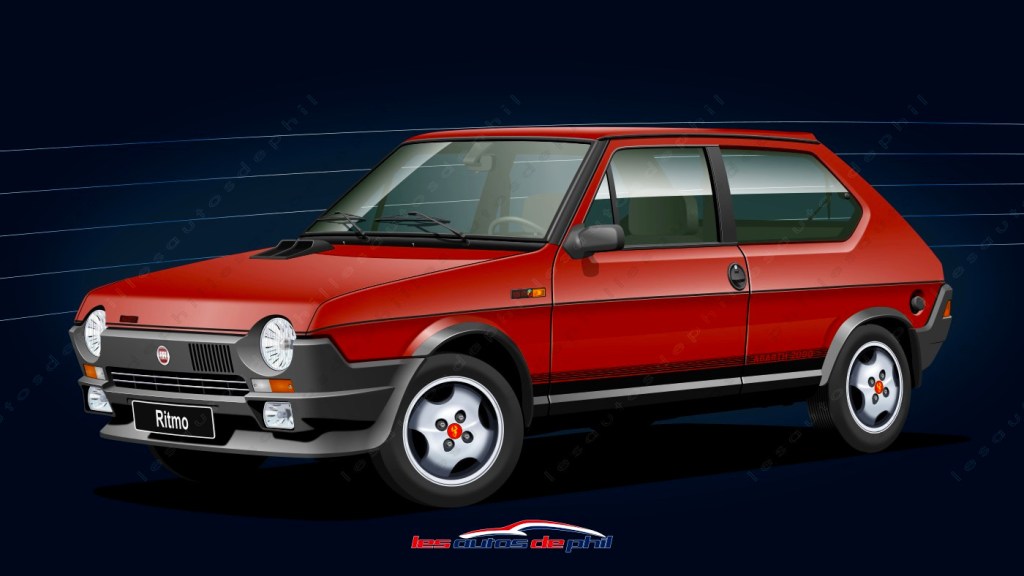
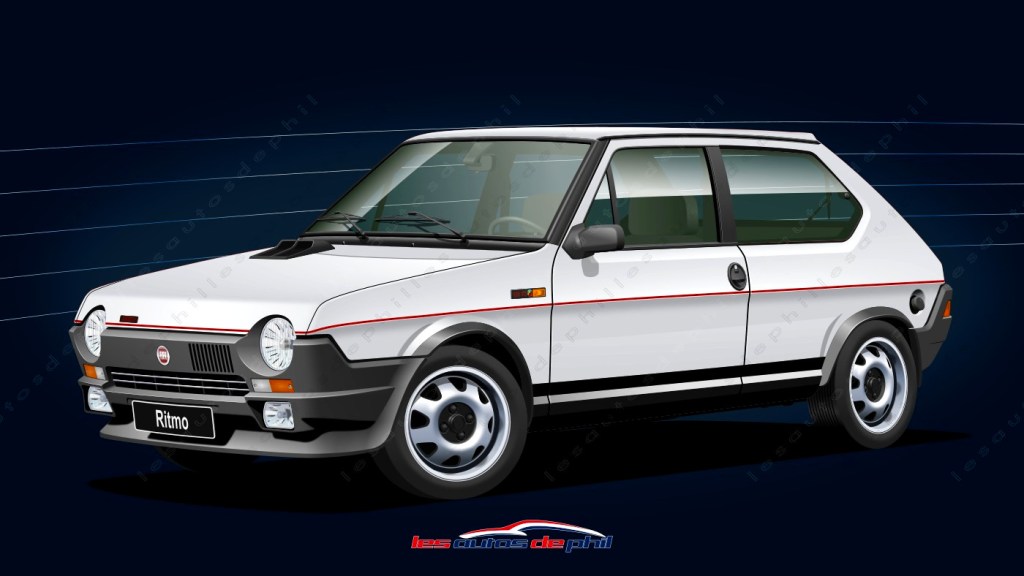
FR – Lors de l’apparition de la Fiat Ritmo en 1978, son design décalé ne m’avait pas emballé. Je ne parle pas de sa forme générale, dans l’air du temps, mais du travail assez osé sur les faces avant et arrière, avec l’intégration des pare-chocs. Alors que la Renault 5 s’est contentée de placer ses boucliers à la même hauteur que des pare-chocs classiques, ceux de la Ritmo remontent bien plus haut, assurant une protection encore plus efficace. À l’arrière, ils intègrent complètement les feux, tandis qu’à l’avant, ils englobent un peu plus de la moitié des phares. C’est sans doute ce qui lui donne ce regard si particulier. Autre détail qui me dérangeait : la dissymétrie des prises d’air du pare-chocs avant ; j’aurais plutôt attendu une ouverture sur toute la largeur. Par contre, les poignées de portes rondes ainsi que le dessin original des jantes me plaisaient bien. Pour mesurer le choc stylistique, rappelez-vous que la Ritmo était destinée à remplacer la très classique 128 !
EN – When the Fiat Ritmo was launched in 1978, its unconventional styling didn’t really appeal to me. I’m not talking about its overall shape, which was very much in keeping with the times, but rather the rather daring treatment of the front and rear ends, particularly the way the bumpers were integrated into the bodywork. Whereas the Renault 5 simply had bumpers positioned at the same height as conventional ones, those of the Ritmo extended much further up the body, providing even better protection. At the rear, they incorporated the lights completely, while at the front they covered just over half of the headlights. This is probably what gives the car its distinctive expression. Another detail that bothered me was the asymmetrical arrangement of the air intakes in the front bumper; I would have preferred a single opening running across the full width. On the other hand, I rather liked the round door handles and the original wheel design. To appreciate just how radical the styling was, remember that the Ritmo was intended to replace the very conventional Fiat 128!
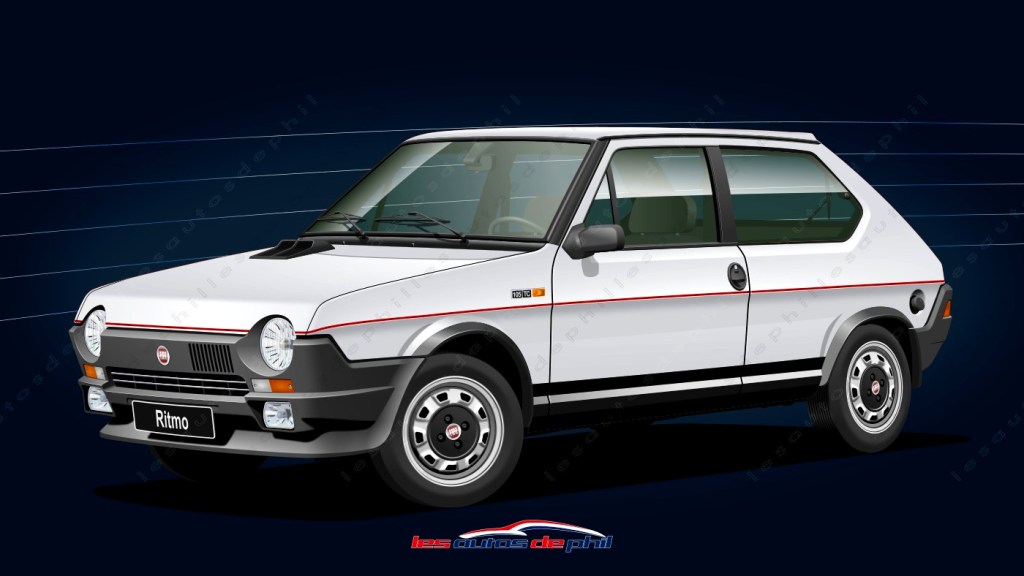
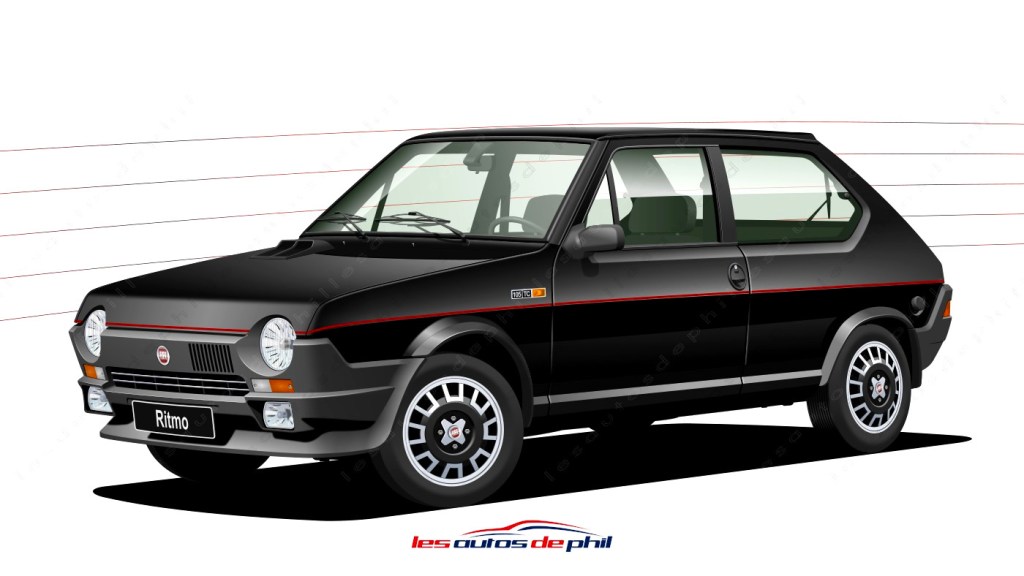
FR – Fiat avait bien senti la mutation du marché des compactes, qui passait résolument des berlines trois volumes à propulsion aux deux volumes à traction avant. Fiat n’a pas été le premier à réaliser cette mue : la Golf, par exemple, était déjà commercialisée depuis quatre ans. Le constructeur italien a donc eu le temps d’étudier la concurrence et d’en retenir le meilleur. Ainsi, le produit est globalement réussi : bonne habitabilité, châssis efficace, confort de bon aloi et moteurs efficaces. Seuls la finition intérieure et l’usage de plastiques durs étaient critiquables, mais ces défauts ont été corrigés par la suite. La gamme, qui démarrait avec les 60, 65 et 75 proposées en deux finitions, évoluera tant au niveau des finitions que des moteurs. La 85 Super est l’une des variantes les plus intéressantes, avec les sportives apparues à partir de 1981. Eh oui, Fiat ne pouvait pas passer à côté du phénomène GTI et proposera la 105 TC, avec son moteur de 1 600 cm³ développant 105 ch, soit pile ce que proposait une grande partie de la concurrence ! Ses qualités routières et ses performances en faisaient une bonne alternative à la référence Golf GTI. Certes, avec son rapport poids/puissance défavorable, la 105 TC sera un peu en retrait en termes de performances pures. Pour battre l’Allemande, il faudra attendre la version 125 TC retravaillée par Abarth. Sa puissance et sa cylindrée supérieures lui permettront de prendre l’avantage. Avec le restylage de 1983, Fiat ira encore plus loin : la puissance portée à 130 ch fera d’elle la GTI la plus performante du moment.
EN – Fiat had correctly anticipated the transformation taking place in the compact-car market, as buyers moved away from three-box, rear-wheel-drive saloons towards two-box, front-wheel-drive hatchbacks. Fiat was not the first to make this transition: the Volkswagen Golf, for example, had already been on sale for four years. The Italian manufacturer therefore had time to study its rivals and take the best from them. Overall, the result was a well-rounded package, with a spacious interior, an effective chassis, good comfort and capable engines. The main criticisms concerned the interior finish and the use of hard plastics, although these shortcomings were addressed in later versions. The range initially comprised the 60, 65 and 75, each available in two trim levels, and would gradually expand in terms of both equipment and engines. The 85 Super was one of the more interesting versions, alongside the sporting models introduced from 1981 onwards. After all, Fiat could hardly ignore the growing GTI phenomenon, and so it introduced the 105 TC, powered by a 1,600 cc engine producing 105 hp — exactly what many of its rivals were offering! Its handling and performance made it a credible alternative to the benchmark Volkswagen Golf GTI. Admittedly, its less favourable power-to-weight ratio meant that it lagged slightly behind in outright performance. To get the better of the German rival, buyers had to wait for the 125 TC, developed by Abarth. Its larger engine and higher output gave it the edge. Fiat went a step further with the 1983 facelift: with power increased to 130 hp, the Ritmo became the fastest GTI of its time.
FR – Le tableau ci-dessous vous permet de vous amuser à comparer les performances des différentes Ritmo avec celles de la référence Golf, dans ses deux versions de 1 600 et 1 800 cm³.
EN – The table below lets you compare the performance figures of the various Ritmo versions with those of the benchmark Golf, in both its 1,600 cc and 1,800 cc forms.
| Golf GTI 1,6 5v | Golf GTi 1,8 | Ritmo 105 TC | Ritmo 125 TC | Ritmo 130 TC | |
Cylindrée | 1588 cm3 | 1781 cm3 | 1585 cm3 | 1995 cm3 | 1995 cm3 |
Puissance | 110 ch | 112 ch | 105 ch | 125 ch | 130 ch |
kg/ch | 9 kg/ch | 8.8 kg/ch | 10 kg/ch | 8,6 kg/ch | 8,3 kg/ch |
0 à 100 km/h | 9,3 s | 9,0 s | 10,9 s | 8,9 s | 8,7 s |
1000 m DA | 31,2 s | 30,6 s | 32,5 s | 30,4 s | 30,0 s |
| de 80 à 120 km/h mini | 6.3 s | 5,8 s | 7,4 s | 5,7 s | 5,6 s |
Vitesse max | 181 km/h | 186 km/h | 176 km/h | 187 km/h | 195 km/h |
FR – Pour mon article, je me suis limité à la première version de la Ritmo, dont le style a fini par me convaincre. En effet, le restylage de 1983 l’a fait rentrer dans le rang et l’a un peu banalisée. Avec le recul des années, je ne peux que confirmer que la première mouture est réellement plus attrayante. Elle dispose d’une vraie personnalité, avec une « gueule » reconnaissable entre toutes. Ne trouvez-vous pas qu’en rabaissant son assiette et en lui appliquant des jantes ATS, elle gagne en prestance ?
EN – For this article, I have focused on the original version of the Ritmo, whose styling eventually won me over. The 1983 facelift, in my opinion, made the car more conventional and robbed it of some of its individuality. Looking back, I can only confirm that the original model is genuinely more appealing. It has a character all of its own, with a face that is instantly recognisable. Don’t you think it looks even more imposing with a lowered ride height and a set of ATS wheels?
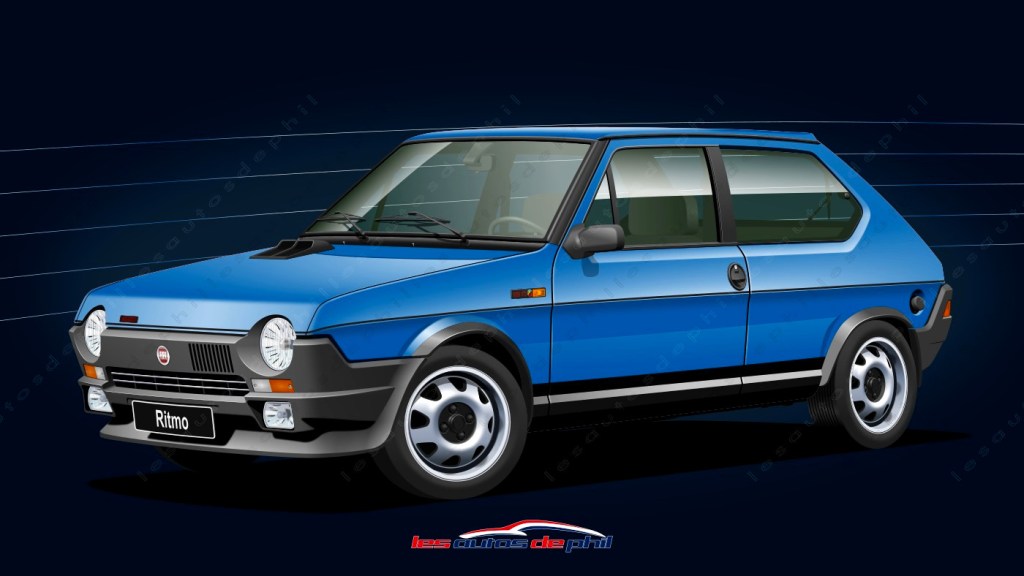
FR – Au final, malgré ses styles osés ou plus sages, la Ritmo a été un grand succès pour FIAT, avec plus de 2 millions d’exemplaires vendus. Par ailleurs, la Lancia Delta lui doit beaucoup puisqu’elle reprend toute sa base mécanique. Enfin, grâce aux accords avec Seat, elle deviendra la Ronda en Espagne.
EN- in the end, whether in its bold original form or its more restrained later guise, the Ritmo was a great success for Fiat, with more than two million examples sold. The Lancia Delta also owes a great deal to it, sharing its entire mechanical platform. And, thanks to agreements with Seat, the Ritmo would go on to become the Ronda in Spain.


Votre commentaire