
Peugeot 905, 908, 9X8, racing as promotion
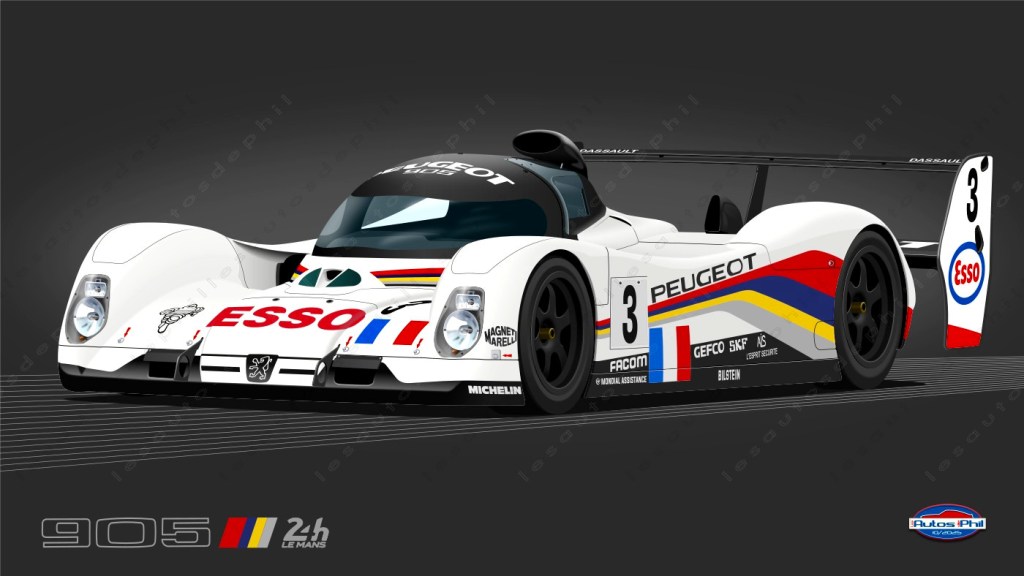
FR – C’est au cours des années 1980 que Peugeot intensifie réellement sa participation aux compétitions automobiles. On se souvient notamment de la 205 Turbo 16, engagée en Groupe B de 1984 à 1986, puis reconvertie dès 1987 pour le Paris-Dakar après l’interdiction de cette catégorie. Elle sera remplacée par la 405 Turbo 16 en 1989 et 1990.
Parallèlement, à la fin des années 1980, Jean Todt décide d’engager Peugeot dans le championnat du monde d’endurance, avec entre autres, l’objectif de remporter les 24 Heures du Mans. Ce sera le rôle dédié à la 905, dotée d’un fantastique moteur V10 de 3,5 litres, à 40 soupapes et développant 650 chevaux. Le son de ce dernier, particulièrement grisant, se distingue nettement de celui de ses concurrentes en endurance, rappelant davantage celui d’une Formule 1.
Aujourd’hui, n’hésitez pas à vous rendre sur des manifestations telles que les 24 heures du Mans classiques pour le (re)découvrir.
Présentée le 4 juillet 1990 à Magny-Cours, la 905 débute sa carrière sportive la même année au Canada, histoire de se rôder. Lors des deux saisons suivantes, Peugeot participe à l’ensemble du championnat et remporte pour la première fois les 24 Heures du Mans en 1992, une année marquée également par le titre mondial.
En 1993, la FIA ayant suspendu le championnat, seule la course du Mans sera disputée par la 905, mais avec éclat : Peugeot réalise un triplé historique !
EN – It was during the 1980s that Peugeot truly intensified its involvement in motor racing. We particularly remember the 205 Turbo 16, entered in Group B from 1984 to 1986, then repurposed for the Paris-Dakar Rally in 1987 after the category was banned. It was later succeeded by the 405 Turbo 16 in 1989 and 1990.
At the same time, in the late 1980s, Jean Todt decided to enter Peugeot in the World Sportscar Championship, with the goal — among others — of winning the 24 Hours of Le Mans. That mission would be entrusted to the 905, powered by a fantastic 3.5-litre V10 engine with 40 valves, producing 650 horsepower. Its exhilarating sound stood apart from other endurance racers, more reminiscent of a Formula 1 car.
Today, enthusiasts can still (re)discover this legend at events such as the Le Mans Classic.
Unveiled on July 4, 1990, at Magny-Cours, the 905 made its racing debut later that year in Canada, a first outing aimed at testing and development. Over the next two seasons, Peugeot competed in the full championship, achieving its first Le Mans victory in 1992 — a year that also brought the world title.
In 1993, after the FIA suspended the championship, the 905 entered only the Le Mans race — but with spectacular success, as Peugeot claimed a historic 1-2-3 finish.
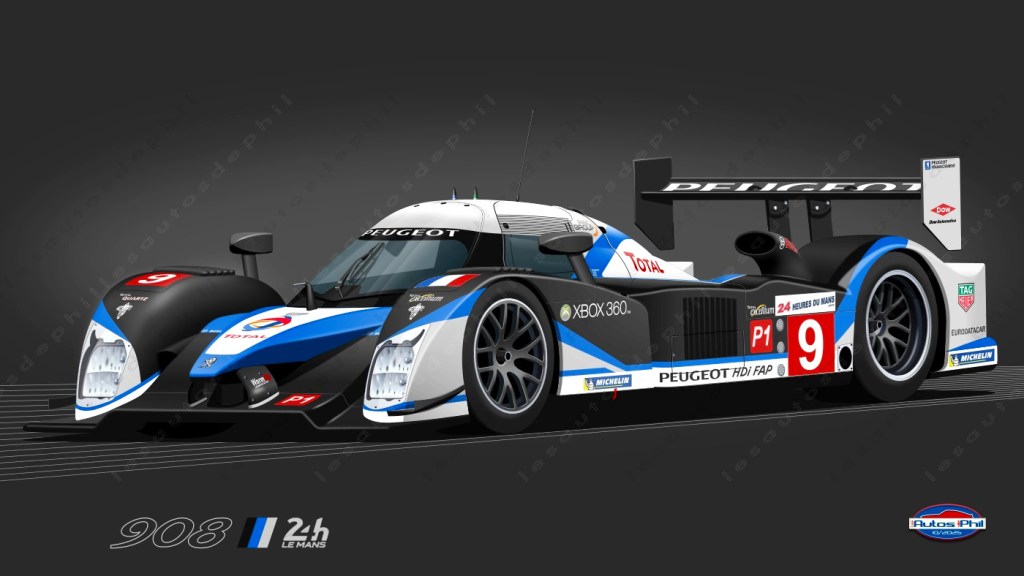
FR – Il faudra ensuite attendre 2006 pour assister au retour de la marque au lion en endurance, cette fois avec la 908. L’objectif est alors de promouvoir la technologie du moteur diesel HDi ainsi que le FAP (filtre à particules). Engagée aux 24 Heures du Mans de 2007 à 2011, la 908 décroche une seule victoire — mais aussi un doublé — en 2009. Les quatre autres éditions se soldent à chaque fois par une deuxième place, la voiture butant toujours sur le redoutable concurrent Audi et ses moteurs diesel TDI. En 2011, avec seulement 13 secondes d’écart après 24 heures de course, la frustration est bien réelle !
Motorisée par un V12 5,5 L de 700 ch pendant trois ans, la 908 adopte ensuite un V8 3,7 L de 550 ch en 2011.
En – It would take until 2006 for the lion-badged brand to return to endurance racing, this time with the 908. The goal was to showcase Peugeot’s HDi diesel engine technology and its innovative particulate filter (FAP). Entered at Le Mans from 2007 to 2011, the 908 scored a single victory — a 1-2 finish in 2009. In the other four editions, it finished runner-up each time, constantly battling its formidable rival Audi and its TDI diesel engines. The frustration peaked in 2011, when Peugeot missed victory by only 13 seconds after 24 hours of racing!
Initially powered by a 5.5-litre V12 delivering 700 hp, the 908 later switched to a 3.7-litre V8 producing 550 hp in 2011.
FR – Une nouvelle pause s’installe avant que Peugeot n’annonce, en 2019, son retour dans la catégorie des Hypercars. La pandémie de Covid-19 bouleverse néanmoins le calendrier : le véritable retour en compétition n’a lieu qu’en 2022, et pour revoir la marque au Mans, il faut même attendre 2023.
Avec la 9X8, Peugeot met cette fois en avant la technologie hybride, associant un moteur thermique V6 2,6 L biturbo de 680 ch à un moteur électrique de 272 ch. La transmission intégrale, symbolisée par le “X” dans sa dénomination, complète cet ensemble.
Malgré une présence régulière entre 2023 et 2025, aucune victoire n’est venue récompenser les efforts de la marque. Le meilleur résultat reste une dixième place obtenue lors de l’édition 2023 des 24 Heures du Mans. Il faut dire que la discipline connaît un véritable regain d’intérêt, attirant un nombre croissant de constructeurs.
Pour illustrer ce sujet, j’ai choisi la version « Art Car » de la 9X8, réalisée en 2023 par l’artiste espagnol J. Demsky. Sa combinaison de motifs géométriques colorés rend cette livrée particulièrement attractive, s’inscrivant dans la tradition des « Art Cars » Porsche et BMW du passé.
EN – Another break followed before Peugeot announced, in 2019, its return to endurance racing in the new Hypercar category. The Covid-19 pandemic disrupted the schedule, delaying the official comeback to 2022 — and fans had to wait until 2023 to see Peugeot back at Le Mans.
With the 9X8, Peugeot set out to highlight hybrid technology, combining a 2.6-litre twin-turbo V6 producing 680 hp with a 272-hp electric motor. All-wheel drive — symbolized by the “X” in its name — completes the package.
Despite regular participation between 2023 and 2025, no victory has rewarded the team’s efforts. The best result so far remains a tenth-place finish at the 2023 24 Hours of Le Mans. Competition has become fiercer than ever, with a growing number of manufacturers joining the discipline.
To illustrate this story, I chose the 2023 “Art Car” version of the 9X8, designed by Spanish artist J. Demsky. Its colorful geometric patterns give the car a striking visual identity, continuing the tradition of iconic Art Cars from Porsche and BMW in the past.

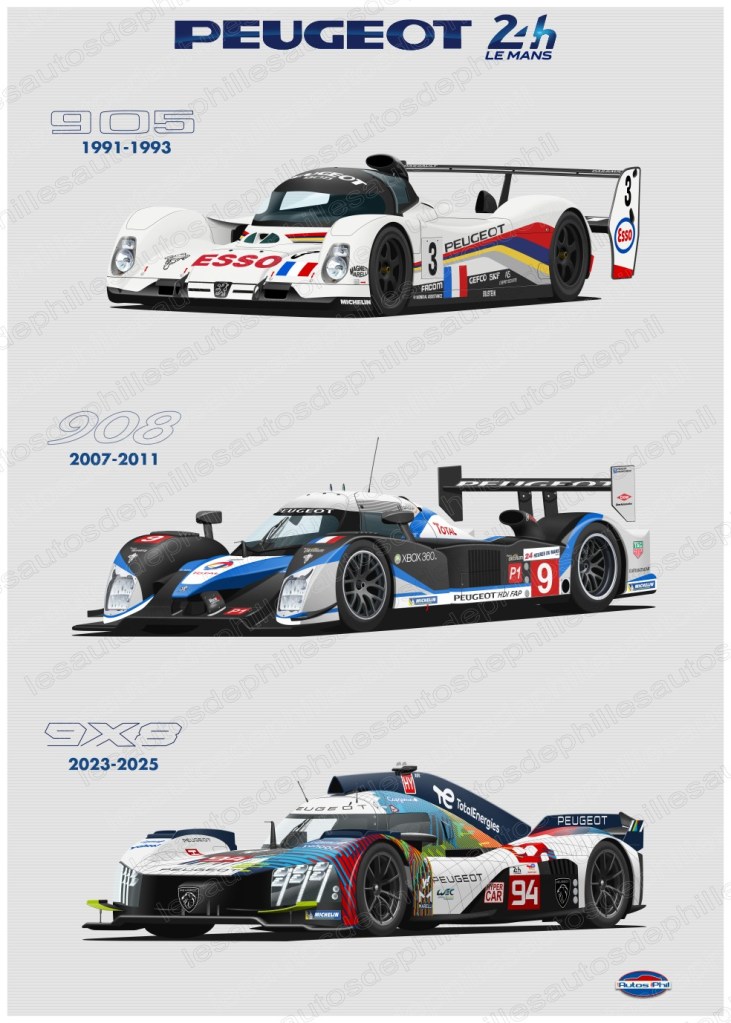
FR – Terminons par une affiche rassemblant ces trois Peugeot sportives
EN – Let’s finish with a poster bringing together these three sporty Peugeots.


 Les Autos de Phil
Répondre à Philippe Bouton Annuler la réponse.