
Ford Capri: A Mustang with a European Twist
FR – Au début des années soixante, dans le but de rajeunir l’image de Ford aux États-Unis, Lee Iacocca, alors vice-président, décide de lancer la Mustang, au style flatteur et au tarif très attractif. Son intuition s’avère excellente, car le succès est immédiat et massif, tant dans son propre pays qu’au-delà de ses frontières. En France, son prix plus élevé la destine avant tout à une clientèle aisée, et notamment à la jet set. Cependant, ses dimensions ne correspondant pas aux standards européens, on décide de reprendre la même recette, mais en l’adaptant aux spécificités de notre continent. C’est ainsi qu’en 1969 naît la Ford Capri, dotée d’un style tout aussi élégant que celui de la Mustang, avec un long capot suggérant des motorisations musclées, donc des performances affûtées. De plus, sa présentation générale et ses équipements flatteurs sauront séduire les acheteurs français, peu habitués à tant d’opulence. C’était la force de Ford, mais également d’Opel : attirer les clients potentiels avec une ligne séduisante, faisant quelque peu oublier une partie mécanique peu innovante, basée sur des solutions classiques. L’avantage d’une telle combinaison est de pouvoir proposer des tarifs agressifs sur des véhicules solides et fiables, au détriment parfois de la tenue de route ou du confort. Sur la Capri, les ressorts des suspensions arrière sont encore à lames, alors que nombre de voitures sont déjà passées aux bien plus confortables et efficaces ressorts hélicoïdaux.
EN – In the early 1960s, in an effort to modernize Ford’s image in the United States, then-vice-president Lee Iacocca launched the Mustang — a sleek-looking car with an incredibly attractive price tag. His instinct was spot on: the Mustang became an immediate and massive success, both at home and abroad. In France, however, its higher price positioned it as a car for the wealthy — especially for the jet set. That said, its dimensions didn’t quite suit European standards. So, Ford decided to apply the same winning formula, but this time tailored to the specific needs of the European market. The result was the 1969 launch of the Ford Capri, a car with styling just as elegant as the Mustang’s — especially its long hood, hinting at powerful engines and sharp performance. Its overall presentation and generous equipment levels were enough to win over French buyers, who weren’t used to such luxury. This was Ford’s strength at the time — and also Opel’s: attracting customers with seductive looks that often made you forget about the relatively conventional mechanics underneath. The benefit of such an approach was the ability to offer attractive pricing on solid, reliable cars — though sometimes at the cost of handling or comfort. On the Capri, for instance, the rear suspension still used leaf springs, while many competitors had already switched to far more comfortable and efficient coil springs.
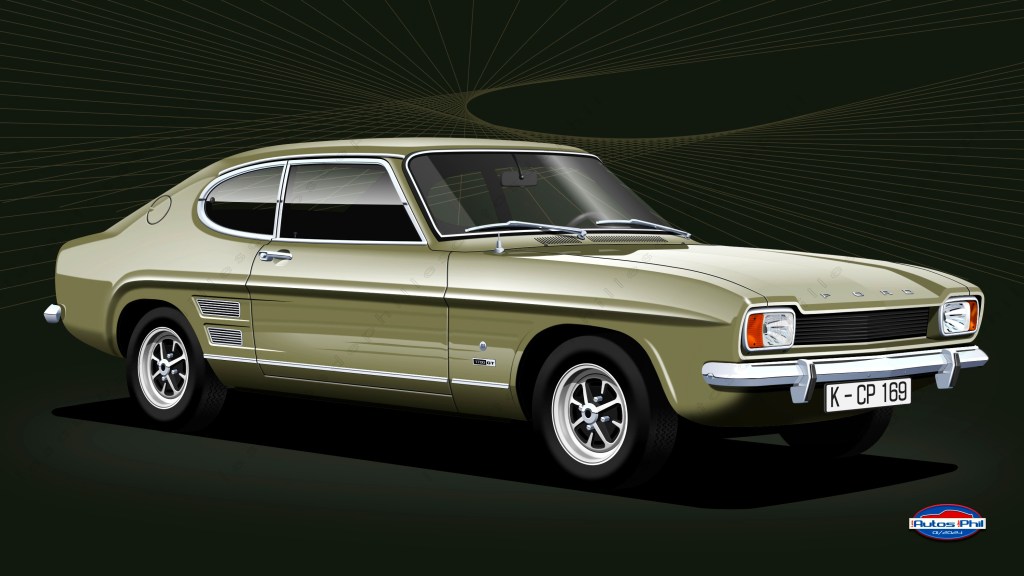


Ford Capri, including one equipped with the famous vinyl roof that was fashionable at the time (click to enlarge)
FR – Autre point séduisant chez Ford : le grand choix de motorisations, de finitions et de packs, que l’on peut combiner à la carte, une pratique quasiment inexistante chez les constructeurs français à l’époque. Ainsi, les motorisations proposées au lancement en 1969 s’étalaient de 1300 à 2000 cm³, avec des moteurs différents selon qu’elles étaient fabriquées en Allemagne ou en Angleterre. Cela peut sembler curieux aujourd’hui, mais à l’époque, les gammes Ford différaient entre les deux pays et ne se rejoindront que progressivement, au fil des années et des rationalisations. Parmi les mécaniques germaniques figurait un prometteur quatre cylindres en V, qui, en réalité, n’était pas réputé pour ses performances sportives. Sa grande qualité résidait dans sa compacité, raison pour laquelle il a d’ailleurs été utilisé par la Matra 530. On pouvait donc se concocter une Capri presque sur mesure : look séduisant, capot noir, chrome, jantes stylisées… tout en optant pour un moteur de base. Le long capot n’était alors que pour la frime ! À l’inverse, on pouvait aussi choisir une configuration sobre extérieurement, mais dotée d’un moteur plus costaud, ce que l’on appelle aujourd’hui un sleeper.
EN – Another advantage Ford had was its wide range of engines, trims, and options — something almost unheard of among French manufacturers at the time. At launch in 1969, engine sizes ranged from 1300 to 2000 cc, with different units depending on whether the car was built in Germany or the UK. This might seem odd today, but back then, Ford’s model ranges in the two countries were quite different and only gradually converged over time. Among the German-made engines was a promising V4, which — despite appearances — wasn’t known for its sporty character. Its main advantage was compactness, which is why it was later used in the Matra 530. Buyers could pretty much custom-build their Capri: go for a sexy look with a black hood, chrome trim, styled wheels and so on, while still choosing a basic engine underneath — the long hood being just for show! Alternatively, you could go for the opposite setup — modest looks but with serious power under the bonnet — what we’d now call a sleeper.
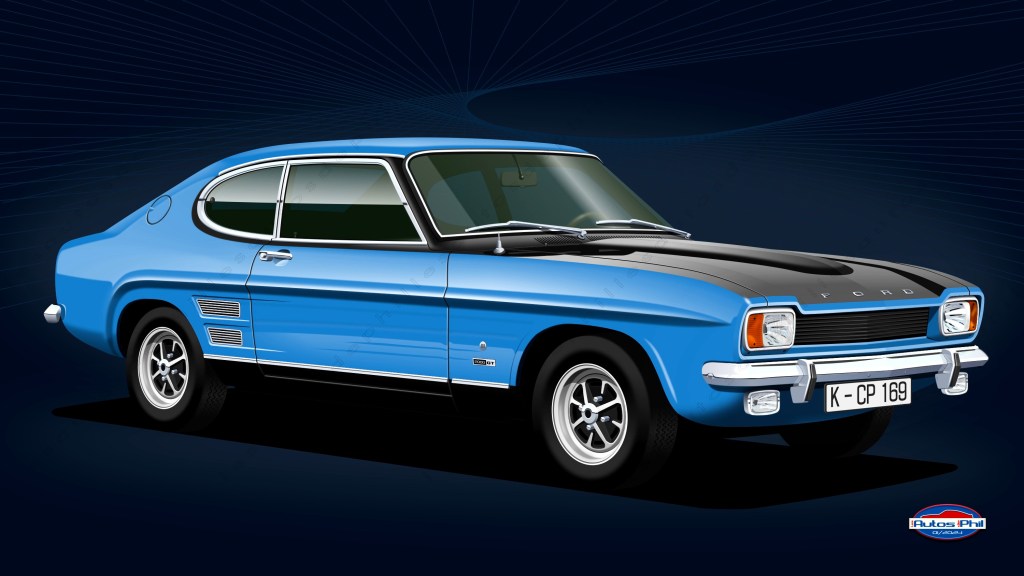
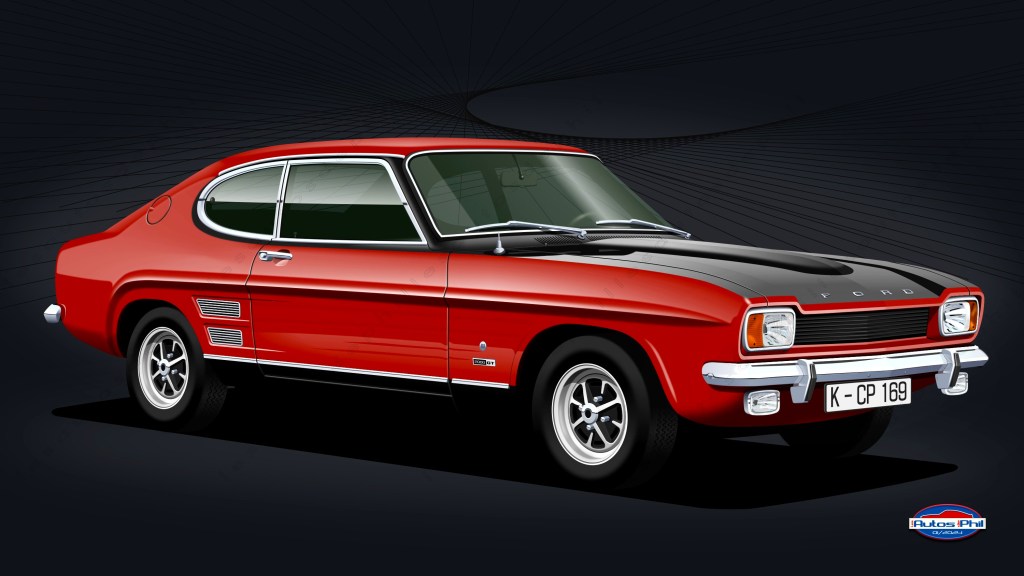
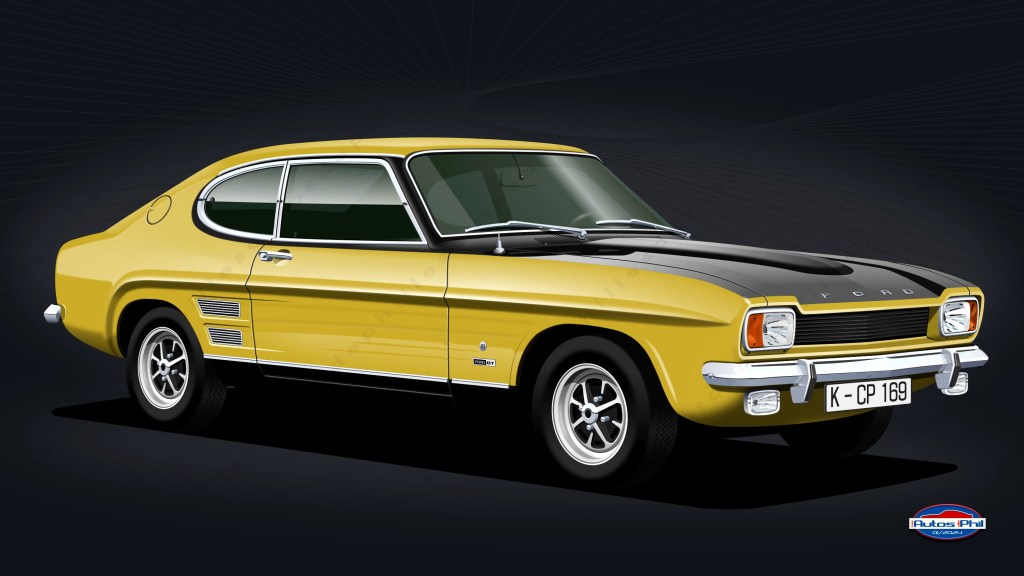
Ford Capri in GT trim and equipped with the ‘R’ package (Click to enlarge)
FR – Tout en haut de la gamme, apparue en cours de carrière, on trouvait la sportive RS2600, conçue avant tout pour la compétition. Certains de ses éléments étaient allégés, ce qui permettait son homologation en sport automobile. La Capri s’y illustrera brillamment dans les années soixante-dix, notamment sur circuit, où elle affrontera des marques réputées comme BMW. Ces participations lui donnèrent une image flatteuse de vraie sportive, à une époque où l’on s’intéressait davantage aux performances qu’au temps de charge ou aux émissions de CO₂ !
EN – At the top of the range came the RS2600, a high-performance version introduced during the model’s run, designed primarily for racing. Some parts were even lightened to meet homologation standards for motorsport. The Capri competed with distinction in 1970s touring car championships, holding its own against big names like BMW. These appearances gave the Capri a strong sporting image — back in the days when people cared more about horsepower than charging times or CO₂ emissions!

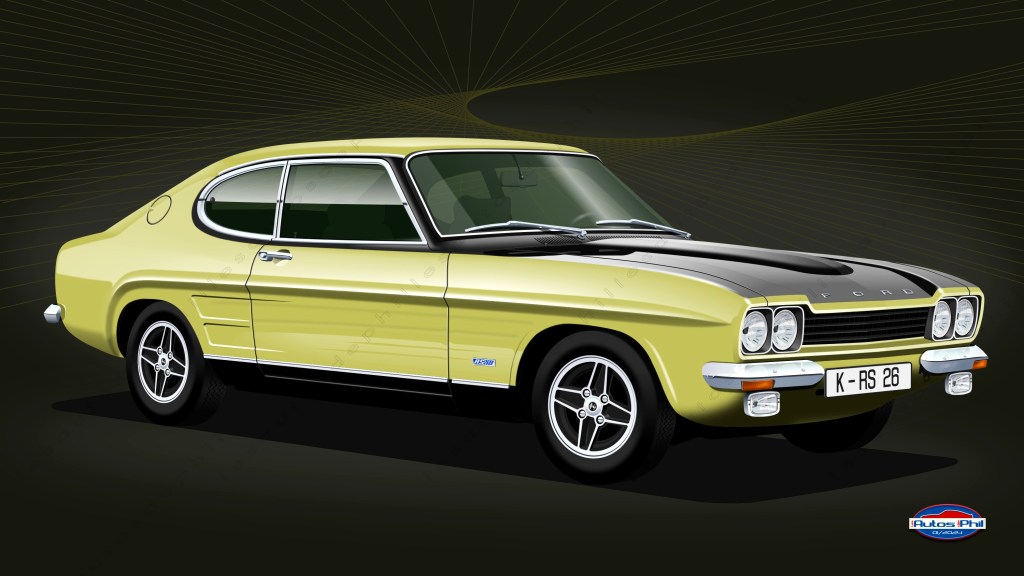
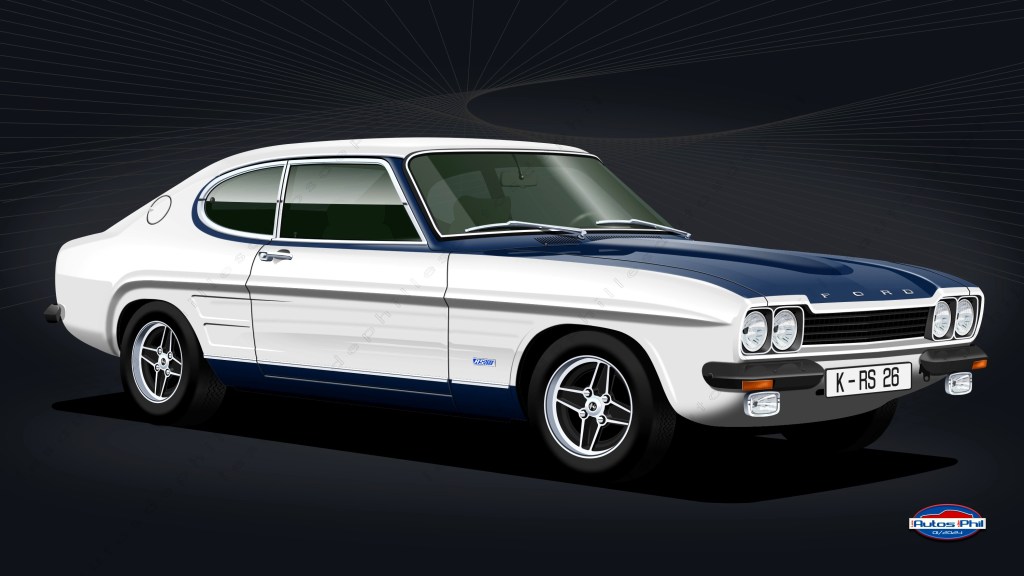
Ford Capri RS 2600 (Click to enlarge)
FR – Rouler en Capri dans ces années-là, c’était poser son homme et susciter l’envie, même si la majorité des modèles furent commandés avec les motorisations les plus abordables. Le succès fut d’ailleurs au rendez-vous : en à peine cinq ans, le cap du million d’exemplaires pour la Capri 1 fut atteint. Elle sera remplacée par la Capri 2, au style similaire mais assagi, intégrant plus de praticité grâce à son hayon. Mais Ford est-il allé trop loin en lissant l’image de son coupé fétiche ? La question se pose, car seulement trois ans plus tard, une troisième version voit le jour, arborant à nouveau un style plus agressif. Malgré cela, les ventes vont stagner — non pas que la Capri 3 manquait de charme ou d’atouts, mais parce que le marché avait évolué, délaissant les coupés de grande série au profit de voitures plus compactes, pratiques et ludiques, bientôt connues sous l’étiquette générique de GTI.
EN – Driving a Capri back then definitely made a statement and sparked envy — even though most were sold with the more affordable engine options. The car was a hit: within just five years, one million Capri Mk1s had been sold. It was replaced by the Capri Mk2, which kept a similar design but offered a more practical layout, including a hatchback. But did Ford go too far in softening the image of its iconic coupé? It’s a valid question, because only three years later, the Capri Mk3 arrived — this time with more aggressive styling again. Still, sales would soon plateau. Not because the Capri lacked charm or appeal — far from it — but because the market itself had changed. Customers were now turning away from big coupés and toward smaller, fun, and practical hot hatches — a new breed soon to be known under the general label of GTI.
FR – Etes-vous intéressé par une des illustrations ci-dessus ?
Contactez-moi sur ce lien et je me ferai un plaisir de vous chiffrer un projet identique ou personnalisé à vos désirs.
EN – Are you interested in any of the illustrations above?
Contact me via this link and I will be happy to provide you with a quote for an identical project or one tailored to your requirements.


 Les Autos de Phil
Laisser un commentaire